Artificial Intelligence (AI) has moved well beyond the experimental stage. From generative AI to high-performance computing (HPC) and real-time analytics, it now drives digital transformation at an unprecedented pace. This acceleration, however, comes with a cost: a sharp rise in energy demand.
According to the International Energy Agency (IEA), AI workloads could account for nearly 4% of global electricity demand by 2030 — a figure that underscores the scale of the challenge for data centre operators.
As discussed in Artificial Intelligence: Beginning a New Reality, AI is more than technological progress. It marks a structural shift that is reshaping every sector. Nowhere is this transformation more visible than in data centres, where energy has become both the fuel of innovation and a limiting factor.
Behind this transformation lies a fundamental electrical challenge: AI computing doesn’t behave like traditional IT. Training cycles can push equipment close to its maximum capacity for hours, followed by sudden drops in power draw. This creates rapidly fluctuating load patterns and unprecedented stress on electrical systems that were designed for stable, predictable operation.
AI systems rely on dense clusters of GPUs that run continuously for days or even weeks, creating power profiles that are far more volatile than traditional IT. As a result, AI data centres face new and complex challenges in maintaining continuity, efficiency and environmental performance.
By 2026, the electrical backbone of these facilities will no longer simply deliver power. It will need to function as an intelligent, connected, and dynamic system — capable of anticipating risks, optimising operations, and supporting decarbonisation.
For a broader view of market dynamics and infrastructure trends, visit the Socomec Data Centre Hub.
The impact of Artificial Intelligence on data centres is both immediate and structural. Training large AI models requires massive computing power and generates energy profiles far more volatile than traditional IT. Traditional enterprise data centres typically consumed 10 to 20 MW. Today, AI-ready sites often require 100 to 300 MW, and some hyperscale campuses are approaching 1 GW — roughly the equivalent of powering 800,000 homes.
High rack densities and continuous GPU workloads are driving new energy profiles, where load variations can reach several hundred percent within milliseconds. These fast transients also affect power factor and harmonic distortion, forcing UPS and distribution systems to maintain stability under conditions never encountered in conventional environments.
Such volatility calls for electrical architectures that combine resilience, rapid response and intelligent load management. Even a brief interruption can corrupt datasets or interrupt complex training processes.
In today’s AI-driven facilities, resilience is no longer a design option — it’s the foundation of operational trust. Redundancy and flexibility now guide every electrical decision. Many operators are turning to centralised Catcher architectures, which allow critical loads to transfer instantly between sources and maintain uninterrupted uptime.
How AI Workloads Impact Power and Cooling Infrastructure
The electrical impact of AI workloads goes far beyond raw power demand. They challenge every layer of a data centre’s backbone—from protection and distribution systems to cooling and monitoring.
Electrical systems that once operated in steady-state conditions must now respond within milliseconds, managing transient loads without voltage deviation or unwanted transfer to bypass. Unlike longer grid disturbances, these ultra-short spikes should be absorbed by UPS electronics rather than by batteries, to avoid premature ageing.
UPS systems and distribution lines must now tolerate unpredictable surges and sharp load drops without compromising continuity. Modular and load-tolerant designs are therefore becoming the new standard. Beyond power protection, the thermal consequences of AI workloads are equally transformative. GPU-intensive racks can exceed 30–40 kW each, making liquid cooling not just desirable but indispensable for efficiency. While this approach reduces thermal stress, it also shifts the energy balance, with cooling now representing a significant share of total consumption. As rack densities climb, facility teams must also manage a dual constraint: maintaining thermal efficiency while integrating heat recovery into broader sustainability strategies.
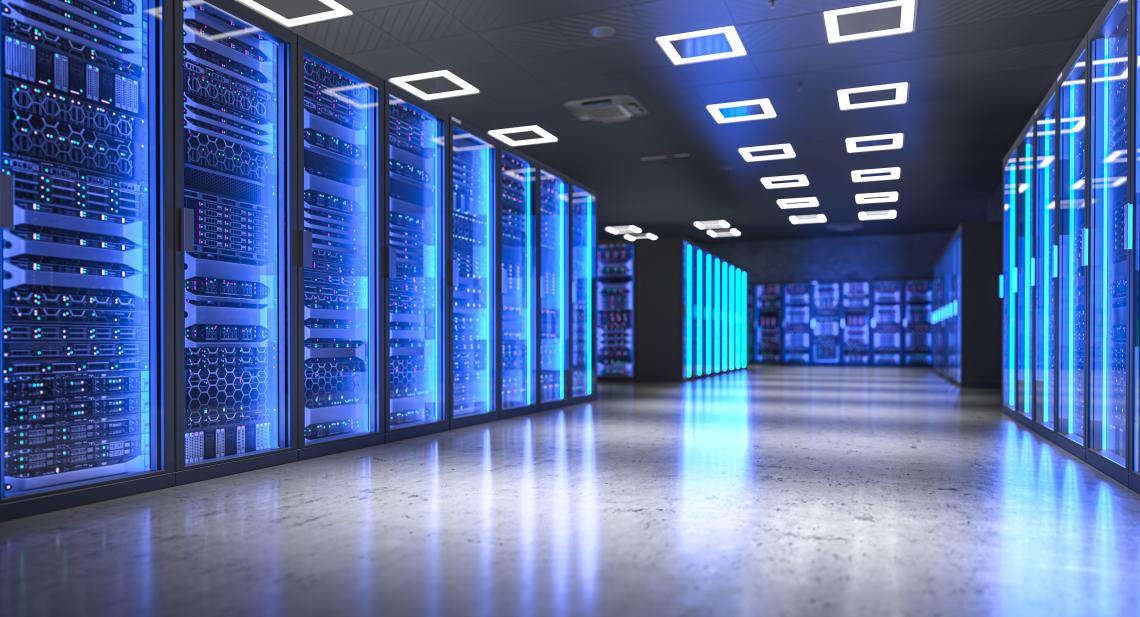
At the same time, the electrical infrastructure itself is becoming data-driven. Each measured point in the power chain provides insight to anticipate risks and fine-tune performance. Smart sensors at source, line and rack level, combined with unified supervision systems, give operators early visibility into potential issues and help streamline maintenance and energy use.
This same visibility allows teams to calculate and track PUE accurately, and to follow the evolution of efficiency over time. By turning thousands of measurements into actionable information, operators can align performance targets with sustainability goals and regulatory frameworks.
As monitoring becomes more integrated, data centre teams are transitioning from local, reactive management to fully connected, predictive environments. This shift is redefining how electrical performance, reliability and maintenance are managed. It is also changing how people work on site: supervision, analytics and automation are now central to daily operations.
Smarter Operations: From Energy Models to Predictive Management
Managing the energy impact of AI data centres requires intelligent, data-driven operations. Predictive energy models can now simulate load behaviour and detect anomalies before they escalate. This allows operators to act early, improving uptime and reducing both operational and carbon costs.
Connected supervision platforms and remote diagnostics enable experts to resolve many issues without physical intervention. This reduces downtime, limits travel-related emissions and accelerates recovery. These predictive and hybrid maintenance approaches combine human expertise with automation, ensuring high performance even under unpredictable workloads.
As AI-driven operations scale up, the ability to correlate electrical, thermal and operational data becomes a differentiator. Facilities that combine modular design with predictive analytics can maintain high performance while avoiding the over-sizing that leads to energy waste.
Meanwhile, infrastructure modularity is becoming a key enabler of flexibility. Oversizing systems for safety is no longer sustainable; modular, right-sized architectures let operators expand capacity in line with actual AI demand. This optimises total cost of ownership while maintaining continuity. In this new paradigm, electrical infrastructures become living systems — adaptive, data-driven, and self-optimising.
Renewable Integration and the Sustainable Data Centre
As energy demand surges, the integration of renewable power has become vital to data centre decarbonisation strategies. The challenge is that renewable generation is intermittent, while AI workloads require constant, high-intensity power. Battery Energy Storage Systems (BESS) are now critical in bridging this gap. They store excess renewable energy when production is high and release it during peaks or outages, making AI operations more grid-compatible and environmentally responsible.
Beyond energy storage, smart grid participation is emerging as a strategic advantage. By combining real-time monitoring, flexibility services, and demand-response participation, AI data centres can balance their environmental footprint with operational reliability.
This evolution toward sustainability also depends on water and heat management. Cooling processes — whether liquid-based or hybrid — must prioritise closed-loop systems to limit water usage and optimise heat recovery. The next generation of AI-ready data centres will measure sustainability not only in megawatts saved but also in litres conserved and carbon avoided.
Towards Intelligent Power Infrastructure: The Future of Data Centres
By 2026, electrical systems will evolve from passive protection devices into intelligent, grid-interactive assets. UPS and storage systems are evolving beyond their traditional backup role. They are now becoming active participants in the grid — supporting demand-response programmes and providing flexibility services that help stabilise local networks.. This transformation reflects a wider shift toward connected, automated infrastructures that continuously adapt to variable AI energy consumption.
Future-ready data centres will operate as intelligent ecosystems, using predictive analytics, digital twins, and autonomous failovers to anticipate demand and maintain uptime. Facility managers will evolve into strategic orchestrators — balancing resilience, energy efficiency, and sustainability while managing risk in real time.
This new model defines the future of data centre infrastructure, where electrical systems are designed not only for protection but for performance and participation in the global energy transition.
The Path Forward: Building Future-Ready AI Infrastructure
AI energy consumption is not a passing trend — it is a structural transformation reshaping the foundations of digital infrastructure. AI data centres consume energy at scales once unimaginable, driven by powerful models and GPU-intensive workloads that push power demand to new heights.
The challenge is not to deliver more energy, but to deliver it better — with precision, efficiency and sustainability at every level of the electrical chain. From predictive energy models to renewable integration, from water-efficient cooling to modular architecture, the path forward requires infrastructures that are intelligent, resilient, and future-ready. AI is transforming the digital world. The data centres that host it must transform as well.
Contact an expert !
Q&A on AI Energy Consumption in Data Centres
How much energy does AI use?
Training a large AI model can consume millions of kilowatt-hours — comparable to powering thousands of homes for a year. Hyperscale AI data centres now plan for 100–300 MW facilities, with some exceeding 1 GW.
How does AI affect power demand in data centres?
AI workloads create sharp, unpredictable peaks in consumption, stressing UPS and distribution equipment. This makes power demand management a central challenge for operators.
Can renewables support AI workloads?
Yes, but intermittency is a challenge. Pairing renewables with BESS allows AI data centres to align variable renewable production with constant workload demand.
What role does cooling play in AI workloads?
Cooling is critical. GPUs generate significant heat, and liquid cooling is becoming standard. However, it raises concerns around water consumption, making sustainable strategies essential.